

Building an Argument
Цель урока
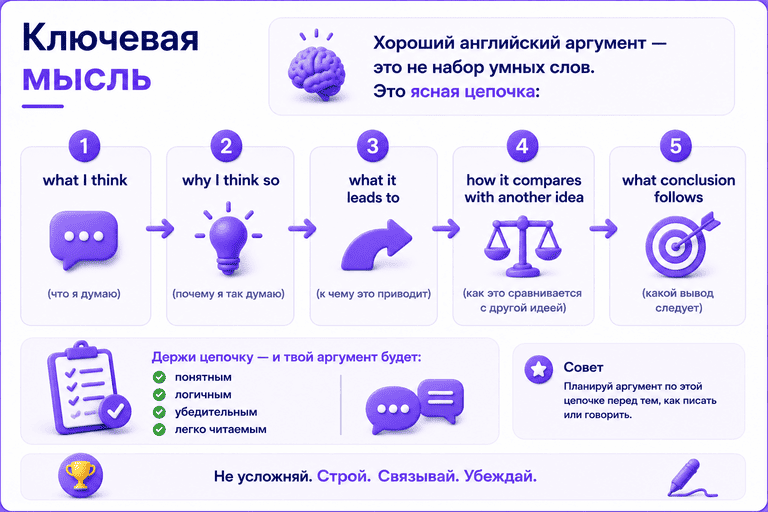
В этом уроке мы разбираем не отдельные слова, а мышление английского аргумента. Ученик должен научиться говорить не просто: “I think it is good”, а строить мысль: мнение → причина → пример → сравнение → результат → вывод.
Это важная тема для уровня B2, потому что на этом уровне человеку уже нужно не только описывать факты, но и объяснять позицию, спорить мягко, сравнивать идеи, обсуждать статьи, новости, работу, обучение, общественные темы и личный опыт.
Главная ошибка русскоговорящего ученика: он часто переводит мысль кусками и получает английский текст, где идеи стоят рядом, но не связаны логикой. В английском такая речь звучит слабее, потому что слушатель должен сам догадываться, где причина, где результат, где противопоставление и где главный вывод.
Что такое argument в английском
Слово argument часто путают со словом “спор”. Да, argument может значить “ссора” или “спор”, но в академическом, деловом и нормальном обсуждении argument чаще означает “аргумент”, “логическая позиция”, “обоснование идеи”.
То есть argument — это не обязательно крик и конфликт. В хорошем английском argument — это построенная мысль. Ты говоришь, что ты думаешь, почему ты так думаешь и чем это подтверждается.
|
Слово |
Прямой смысл |
Как использовать |
|
аргумент / позиция / довод |
The main argument is that online learning saves time. |
|
|
причина |
The main reason is the lack of practice. |
|
|
доказательство / подтверждение |
There is clear evidence that sleep affects memory. |
|
|
пример |
For example, many students remember words better with pictures. |
|
|
вывод |
Therefore, regular practice is more important than long lessons. |
|
|
контраргумент |
A common counterargument is that online learning can feel less personal. |
Главная формула сильного аргумента
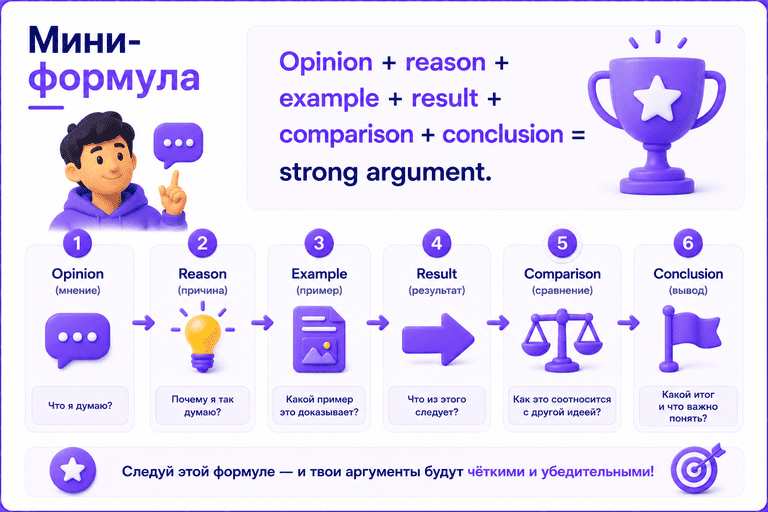
Базовая модель аргумента в английском выглядит так:
|
Шаг |
Функция |
Типичные фразы |
|
1. Claim |
главная мысль / позиция |
I believe that... / The main idea is that... / It seems clear that... |
|
2. Reason |
почему ты так думаешь |
This is because... / The main reason is that... / One reason is that... |
|
3. Evidence or example |
пример или подтверждение |
For example... / This can be seen in... / A clear example is... |
|
4. Result |
что из этого следует |
As a result... / This leads to... / Therefore... |
|
5. Comparison |
сравнение с другой идеей |
Compared with... / Unlike... / Whereas... / In contrast... |
|
6. Conclusion |
итог |
This means that... / Overall... / For this reason... |
В живой речи не всегда нужно использовать все 6 шагов. Но если ученик понимает эту модель, он перестаёт говорить обрывками. Его речь становится похожа на нормальное взрослое объяснение.
Русская логика vs английская логика
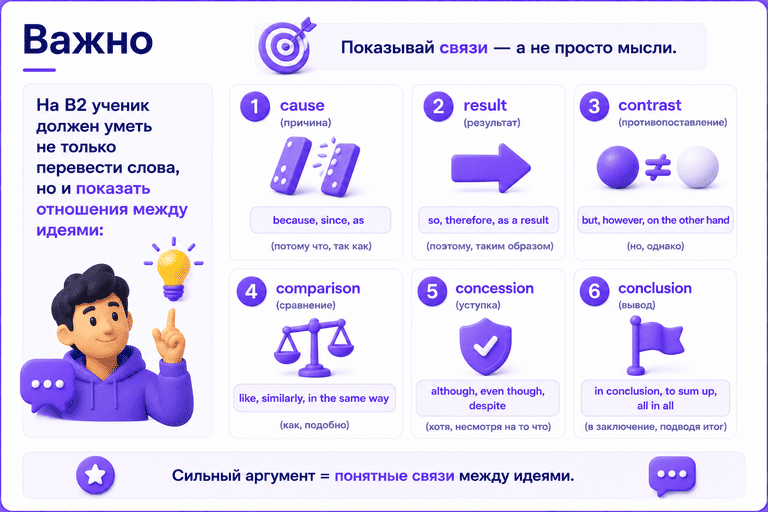
В русском разговоре мы часто можем сказать мысль более свободно: “Это плохая идея, времени нет, люди устанут, лучше сделать позже”. Русский слушатель легко достраивает связи. В английском, особенно на B2 и выше, лучше явно показать связи между идеями.
|
Русская логика |
Слабый английский перевод |
Сильный английский вариант |
|
Это плохая идея, времени нет. |
It is a bad idea, there is no time. |
It is probably a bad idea because there is not enough time. |
|
Люди устанут, результат будет хуже. |
People will be tired, the result will be worse. |
People will be tired, and as a result, the final result may be worse. |
|
Первый вариант проще, второй дороже. |
The first option is easier, the second is more expensive. |
The first option is easier, whereas the second one is more expensive. |
|
Можно сделать сейчас, но риск большой. |
We can do it now, but the risk is big. |
Although we can do it now, the risk is still quite high. |
Claim: как сказать главную мысль
Claim — это центральная мысль, которую ты потом доказываешь. В русском это может быть “я считаю”, “главная проблема”, “лучшее решение”, “важная причина”. В английском лучше начать аргумент с ясной позиции.
|
Фраза |
Перевод |
Уровень силы |
Пример |
|
Я думаю, что... |
нейтрально / разговорно |
I think that small daily practice is better than one long lesson. |
|
|
Я считаю / верю, что... |
чуть сильнее |
I believe that grammar is easier when students see real examples. |
|
|
По моему мнению,... |
нейтрально |
In my opinion, online courses should be more practical. |
|
|
Главная мысль в том, что... |
ясно и сильно |
The main point is that motivation is not enough without a system. |
|
|
Кажется очевидным, что... |
осторожно, но уверенно |
It seems clear that social media affects attention. |
|
|
Есть сильный аргумент, что... |
формально / B2 |
There is a strong argument that public transport should be cheaper. |
Не начинай каждый аргумент с I think. Это нормально на A1-A2, но на B2 речь начинает звучать бедно. Лучше менять вводные фразы, чтобы мысль звучала взрослее.
Reason: как объяснить причину
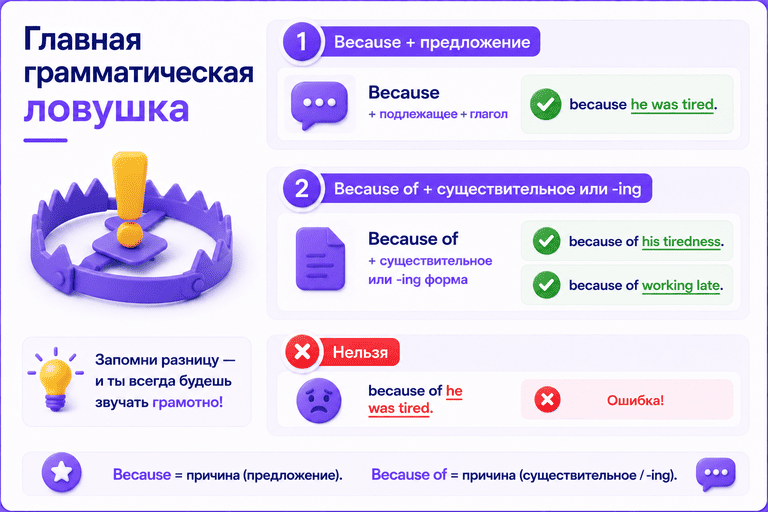
Причина отвечает на вопрос why? В английском есть несколько способов показать причину. Самые частые: because, since, as, because of, due to, the reason is that.
|
Фраза |
После неё идёт |
Стиль |
Пример |
|
because |
полное предложение |
самое частое, универсальное |
Many students give up because they do not see progress quickly. |
|
since |
полное предложение |
мягко, немного формальнее |
Since the task is difficult, students need clear steps. |
|
as |
полное предложение |
формальнее / письменнее |
As the market is unstable, traders should manage risk carefully. |
|
because of |
существительное / -ing |
часто в речи и письме |
The lesson was hard because of the new vocabulary. |
|
due to |
существительное / -ing |
формальнее |
The delay was due to technical problems. |
|
the reason is that |
полное предложение |
объясняет прямо |
The reason is that people need repetition. |
Because vs because of vs due to
Эта разница очень важна, потому что русское “из-за / потому что” часто переводится одним способом в голове ученика, но в английском грамматика после связки разная.
|
Русская идея |
Правильно |
Неправильно |
Почему |
|
из-за дождя |
because of the rain |
because the rain |
because требует предложение, а не просто существительное |
|
потому что шёл дождь |
because it was raining |
because of it was raining |
because of не ставится перед полным предложением |
|
из-за ошибки |
due to a mistake |
due to he made a mistake |
due to обычно требует noun phrase |
|
потому что он ошибся |
because he made a mistake |
because of he made a mistake |
после because идёт subject + verb |
В B2-письме due to звучит нормально, но не надо пихать его везде. Иногда простой because звучит лучше и естественнее.
Result: как показать следствие
Следствие отвечает на вопрос: “и что из этого получилось?” или “к чему это привело?” В английском это очень важная часть аргумента. Без неё мысль может звучать незаконченной.
|
Фраза |
Перевод |
Стиль |
Пример |
|
поэтому / так что |
разговорно, просто |
He did not practise, so he forgot the words. |
|
|
следовательно / поэтому |
формально, эссе |
The method is simple; therefore, it is suitable for beginners. |
|
|
в результате |
нейтрально / письменно |
The explanation was clear. As a result, students made fewer mistakes. |
|
|
вследствие этого |
формально |
The cost increased; consequently, fewer people joined the course. |
|
|
это приводит к |
B2, аналитично |
Lack of sleep leads to lower concentration. |
|
|
это означает, что |
ясный вывод |
This means that the system needs to be simpler. |
So — самый живой и простой вариант. Therefore — сильнее и официальнее. As a result — хороший нейтральный вариант для статей и объяснений. Consequently звучит академичнее, поэтому в обычной речи его лучше не использовать слишком часто.
Compare: как сравнивать идеи
Сравнение идей нужно, когда ты обсуждаешь два подхода, две причины, две стороны проблемы или два решения. На B2 очень важно уметь не только сказать “A is good, B is bad”, а показать точную связь между A и B.
|
Фраза |
Перевод |
Что делает |
Пример |
|
compared with / compared to |
по сравнению с |
прямое сравнение |
Compared with traditional lessons, online lessons are more flexible. |
|
в отличие от |
показывает различие |
Unlike short videos, full lessons give more context. |
|
|
тогда как |
сравнивает два контраста |
Some students need grammar, whereas others need more speaking practice. |
|
|
в то время как / хотя |
мягкое сравнение |
While the first option is cheaper, the second one is safer. |
|
|
в отличие от этого |
резкий контраст |
The first plan saves time. In contrast, the second plan gives better quality. |
|
|
с другой стороны |
показывает вторую сторону |
The course is expensive. On the other hand, it saves months of work. |
While vs whereas: тонкая разница
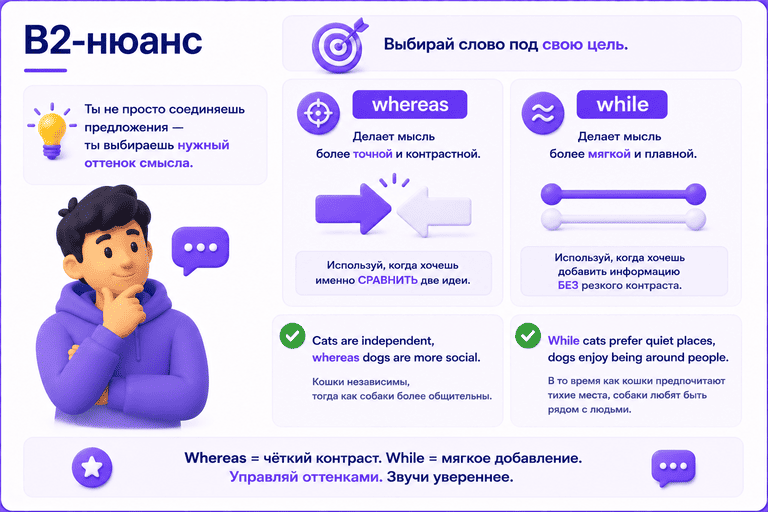
While и whereas часто переводятся похоже: “тогда как”, “в то время как”. Но оттенок разный. Whereas обычно звучит более чётко и контрастно. While может быть мягче и разговорнее, а также может значить “пока / в то время как” в смысле времени.
|
Фраза |
Оттенок |
Пример |
Комментарий |
|
whereas |
чёткое логическое противопоставление |
Small lessons are easier to finish, whereas long lessons can feel overwhelming. |
хорошо для эссе и аналитики |
|
while |
мягкое противопоставление или одновременность |
While online learning is flexible, it requires discipline. |
часто используется как “хотя” |
|
while |
временное значение |
She listened to a podcast while she was cooking. |
это уже не сравнение идей |
Contrast and concession: как признать другую сторону
Сильный аргумент не всегда давит только одну сторону. Взрослая речь часто признаёт, что у другой позиции тоже есть смысл. Это называется concession: “да, это правда, но...”.
|
Фраза |
Перевод |
Грамматика |
Пример |
|
хотя |
although + sentence |
Although the idea is risky, it may work. |
|
|
даже хотя / несмотря на то что |
even though + sentence |
Even though the course is difficult, it is useful. |
|
|
несмотря на |
despite + noun / -ing |
Despite the high price, many people bought it. |
|
|
несмотря на |
in spite of + noun / -ing |
In spite of working hard, he did not pass the test. |
|
|
однако |
отдельное слово-связка |
The plan is simple. However, it requires time. |
|
|
тем не менее |
формальнее |
The evidence is limited. Nevertheless, the idea is worth discussing. |
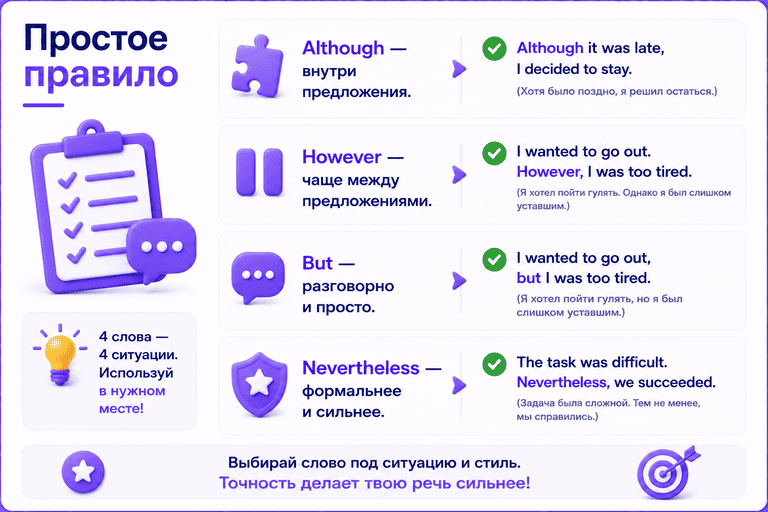
Очень частая ошибка: Although ..., but ... В английском обычно не нужно ставить although и but вместе в одной структуре. Правильно: Although the idea is risky, it may work. Или: The idea is risky, but it may work.
Although vs however
Although соединяет две части внутри одного предложения. However обычно соединяет две отдельные мысли или два предложения. В русском оба могут ощущаться как “однако / хотя”, но английская структура другая.
|
Русская мысль |
Although |
However |
|
Идея дорогая, но полезная. |
Although the idea is expensive, it is useful. |
The idea is expensive. However, it is useful. |
|
Метод простой, но требует дисциплины. |
Although the method is simple, it requires discipline. |
The method is simple. However, it requires discipline. |
|
Результат хороший, хотя времени было мало. |
Although there was little time, the result was good. |
There was little time. However, the result was good. |
Evidence: как подтверждать мысль
На B2 недостаточно сказать “I think”. Нужно показать, почему твоя мысль не висит в воздухе. Evidence может быть фактом, примером, наблюдением, опытом или логическим объяснением.
|
Фраза |
Перевод |
Пример |
|
Например,... |
For example, students often remember words better when they see pictures. |
|
|
Яркий пример — это... |
A clear example is the growth of short educational videos. |
|
|
Это можно увидеть в... |
This can be seen in many online courses. |
|
|
Это говорит о том, что... |
This suggests that people need shorter and clearer explanations. |
|
|
Это показывает, что... |
This shows that repetition is more important than motivation. |
|
|
На практике,... |
In practice, many learners stop when the system is too complicated. |
Фраза this suggests that звучит взрослее, чем this says that. Она показывает вывод, но не делает его слишком агрессивным. Это полезная B2-фраза для статей, эссе и обсуждений.
Cause and effect: большая таблица связок
|
Связь |
Фраза |
Перевод |
Пример |
|
Причина |
because |
потому что |
People lose focus because they try to learn too much at once. |
|
Причина |
because of |
из-за |
The result was worse because of poor planning. |
|
Причина |
due to |
из-за / вследствие |
The meeting was cancelled due to a lack of time. |
|
Причина |
the main reason is that |
главная причина в том, что |
The main reason is that the instructions were unclear. |
|
Причина |
one possible explanation is that |
одно возможное объяснение в том, что |
One possible explanation is that students need faster feedback. |
|
Следствие |
so |
поэтому |
The topic was difficult, so we repeated it. |
|
Следствие |
as a result |
в результате |
He practised every day. As a result, his speaking became more natural. |
|
Следствие |
therefore |
следовательно / поэтому |
The evidence is weak; therefore, the conclusion is not convincing. |
|
Следствие |
this leads to |
это приводит к |
Too many rules lead to confusion. |
|
Следствие |
this results in |
это приводит к / даёт результат |
Regular revision results in better long-term memory. |
How to build a paragraph: от простой мысли к B2-абзацу
Посмотрим, как простая мысль превращается в нормальный английский аргумент.
|
Уровень |
Вариант |
|
A1-A2 |
Online learning is good because it is easy. |
|
B1 |
Online learning is useful because students can study at home and save time. |
|
B2 |
Online learning can be more effective than traditional lessons for busy adults because it gives them more flexibility. For example, they can repeat difficult parts, pause the lesson and study when they have time. As a result, they are more likely to continue learning instead of giving up. |
B2-вариант не обязательно использует редкие слова. Он просто лучше связан логикой: claim → comparison → reason → example → result.
Разбор B2-абзаца по частям
Абзац: Online learning can be more effective than traditional lessons for busy adults because it gives them more flexibility. For example, they can repeat difficult parts, pause the lesson and study when they have time. As a result, they are more likely to continue learning instead of giving up.
|
Часть |
Фрагмент |
Функция |
|
Claim |
Online learning can be more effective... |
главная мысль |
|
Comparison |
than traditional lessons |
сравнение двух идей |
|
Target group |
for busy adults |
уточнение, для кого это верно |
|
Reason |
because it gives them more flexibility |
причина |
|
Example |
For example, they can repeat... |
подтверждение |
|
Result |
As a result, they are more likely... |
следствие |
|
Contrast inside result |
instead of giving up |
сравнение результата с плохой альтернативой |
Почему нельзя просто ставить идеи рядом
Когда идеи стоят рядом без связок, английская речь звучит как список. Слушатель понимает отдельные предложения, но не всегда видит, какую мысль ты доказываешь.
|
Слабо |
Сильнее |
Почему сильнее |
|
The app is useful. It is simple. People like it. |
The app is useful because it is simple, and as a result, more people are willing to use it. |
появилась причина и следствие |
|
The first plan is fast. The second plan is safe. |
The first plan is faster, whereas the second one is safer. |
появилось точное сравнение |
|
The lesson is difficult. Students need examples. |
Since the lesson is difficult, students need clear examples. |
первая мысль стала причиной второй |
|
He practised every day. He improved. |
He practised every day; therefore, he improved. |
результат показан явно |
Mini-scenario 1: обсуждение обучения
Ситуация: человек обсуждает, почему короткие уроки могут быть лучше длинных.
Weak version: Short lessons are good. Long lessons are hard. Students do not finish them.
Strong B2 version: Short lessons can be more effective for beginners because they reduce pressure and make progress feel easier. In contrast, long lessons often look serious, but they can be overwhelming. As a result, students may start with motivation and then quickly give up.
|
Элемент |
Где он в тексте |
|
Главная мысль |
Short lessons can be more effective for beginners |
|
Причина |
because they reduce pressure |
|
Сравнение |
In contrast, long lessons... |
|
Следствие |
As a result, students may... give up |
Mini-scenario 2: обсуждение работы
Ситуация: нужно сравнить удалённую работу и офис.
Remote work gives employees more freedom, whereas office work often creates better communication inside a team. The main advantage of remote work is flexibility: people can plan their day around deep work instead of constant interruptions. However, this freedom can also become a problem if there is no clear structure. Therefore, the best solution is often a hybrid model, because it combines flexibility with regular face-to-face communication.
Здесь аргумент сильный, потому что автор не говорит “remote work good, office bad”. Он признаёт две стороны, сравнивает, показывает риск и делает вывод.
Mini-scenario 3: обсуждение трейдинга и риска
Ситуация: объяснить, почему дисциплина важнее одной удачной сделки.
One lucky trade can bring money quickly, but it does not prove that a trader has a strong strategy. The main reason is that short-term results can be random. For example, a beginner may win several trades in a row and start increasing risk without understanding the market. As a result, one emotional decision can destroy the whole deposit. Therefore, discipline and risk management are more important than a single big win.
|
Функция |
Фраза |
|
Контраст |
One lucky trade can bring money quickly, but... |
|
Причина |
The main reason is that... |
|
Пример |
For example... |
|
Следствие |
As a result... |
|
Вывод |
Therefore... |
Большой блок примеров: причина и следствие
|
Русская идея |
English |
Что делает фраза |
|
Он не повторял слова, поэтому быстро их забыл. |
He did not revise the words, so he quickly forgot them. |
простое следствие |
|
Так как тема была сложной, учитель дал больше примеров. |
Since the topic was difficult, the teacher gave more examples. |
причина в начале |
|
Урок был полезным, потому что в нём были реальные ситуации. |
The lesson was useful because it had real situations. |
because + предложение |
|
Из-за плохого плана команда потеряла время. |
Because of a poor plan, the team lost time. |
because of + noun phrase |
|
Задержка произошла из-за технической ошибки. |
The delay happened due to a technical error. |
due to + noun phrase |
|
Он тренировался каждый день. В результате его речь стала увереннее. |
He practised every day. As a result, his speech became more confident. |
результат отдельным предложением |
|
Доказательство слабое, поэтому вывод неубедительный. |
The evidence is weak; therefore, the conclusion is not convincing. |
формальный вывод |
|
Слишком много правил приводит к путанице. |
Too many rules lead to confusion. |
cause → effect |
|
Недостаток сна влияет на память и концентрацию. |
Lack of sleep affects memory and concentration. |
причина выражена существительным |
|
Он не получил обратную связь, поэтому повторил ту же ошибку. |
He did not get feedback, so he repeated the same mistake. |
живой разговорный вариант |
Большой блок примеров: сравнение идей
|
Русская идея |
English |
Что делает фраза |
|
Первый вариант дешевле, тогда как второй безопаснее. |
The first option is cheaper, whereas the second one is safer. |
whereas показывает контраст |
|
По сравнению с обычными уроками, видеоуроки легче повторять. |
Compared with regular lessons, video lessons are easier to repeat. |
compared with |
|
В отличие от коротких роликов, длинные уроки дают больше контекста. |
Unlike short videos, long lessons give more context. |
unlike |
|
Один подход быстрый, а другой более надёжный. |
One approach is fast, while the other is more reliable. |
while как сравнение |
|
С одной стороны, система сложная. С другой стороны, она даёт точные результаты. |
On the one hand, the system is complex. On the other hand, it gives accurate results. |
две стороны аргумента |
|
Первое решение экономит время. В отличие от этого, второе улучшает качество. |
The first solution saves time. In contrast, the second one improves quality. |
резкий контраст |
|
Книги дают глубину, а приложения дают скорость. |
Books give depth, whereas apps give speed. |
короткое точное сравнение |
|
Хотя цена выше, качество тоже лучше. |
While the price is higher, the quality is also better. |
while как мягкое although |
Большой блок примеров: контраргумент
Контраргумент нужен, когда ты хочешь показать, что видишь другую сторону вопроса. Это делает речь умнее и честнее.
|
Фраза |
Перевод |
Пример |
|
A common counterargument is that... |
Частый контраргумент в том, что... |
A common counterargument is that online learning lacks personal contact. |
|
Some people argue that... |
Некоторые утверждают, что... |
Some people argue that short videos make students less focused. |
|
This may be true, but... |
Это может быть правдой, но... |
This may be true, but short videos can still be useful for revision. |
|
It is true that..., however... |
Верно, что..., однако... |
It is true that grammar is difficult; however, clear examples make it easier. |
|
Even if this is true,... |
Даже если это правда,... |
Even if this is true, the method still has practical value. |
Такие фразы особенно полезны, когда ученик обсуждает статью, новость, идею, метод, продукт или спорную тему.
Как строить ответ при обсуждении статьи
Урок 94 будет отдельно про Discussing Articles, но здесь важно увидеть связь: когда ты обсуждаешь статью, тебе почти всегда нужен аргумент. Ты не просто пересказываешь текст. Ты реагируешь на идею автора.
|
Задача |
Полезная модель |
|
Согласиться с автором |
I agree with the author because... |
|
Не согласиться |
I partly disagree because... |
|
Добавить причину |
Another reason is that... |
|
Показать результат |
This can lead to... |
|
Сравнить с другой идеей |
Compared with this approach,... |
|
Сделать вывод |
Overall, the article shows that... |
Хороший ответ на статью обычно звучит так: “The author argues that... I agree with this point because... For example... However... Overall...”
Почему нельзя переводить “аргумент” как quarrel
Quarrel — это ссора. Argument может быть и ссорой, и аргументом, но в учебных и академических темах чаще нужен именно argument как “довод”. Если сказать “I have a quarrel for this idea”, это будет неправильно. Нужно: I have an argument for this idea / There is a strong argument for this idea.
|
Русская мысль |
Правильно |
Неправильно |
|
У меня есть аргумент. |
I have an argument. |
I have a quarrel. |
|
Это сильный довод. |
This is a strong argument. |
This is a strong quarrel. |
|
Они поссорились. |
They had an argument. / They had a quarrel. |
They had an evidence. |
|
Аргумент автора слабый. |
The author's argument is weak. |
The author's quarrel is weak. |
Strong argument vs weak argument
Сильный аргумент не обязан быть длинным. Он должен быть ясным, связанным и доказанным. Слабый аргумент часто звучит эмоционально, но без причины или примера.
|
Слабый аргумент |
Почему слабый |
Сильный вариант |
|
This is bad. |
нет причины |
This is a weak solution because it solves only part of the problem. |
|
Everyone knows it. |
нет доказательства |
This can be seen in many beginner courses where students stop after the first month. |
|
It is better. |
не ясно, чем лучше |
It is better for beginners because it is simpler and easier to repeat. |
|
The other idea is stupid. |
эмоционально и грубо |
The other idea is less practical because it requires more time and money. |
|
B2-мышление |
“Почему нельзя другое слово”: because / so / therefore / as a result
Многие ученики знают все эти слова, но используют их как одинаковые “поэтому / потому что”. На самом деле они стоят в разных местах логической цепочки.
|
Фраза |
Логическая роль |
Нельзя использовать вместо |
Пример |
|
because |
причина |
therefore |
I stayed home because I was tired. |
|
so |
простое следствие |
because |
I was tired, so I stayed home. |
|
therefore |
формальный вывод |
because |
The data is limited; therefore, the conclusion is weak. |
|
as a result |
результат действия/ситуации |
because of |
He ignored the rules. As a result, he lost money. |
Простейшая схема: because смотрит назад на причину, so/therefore/as a result смотрят вперёд на следствие.
Пунктуация и связки
На уровне B2 пунктуация начинает влиять на восприятие текста. Особенно это важно с however, therefore, as a result, in contrast.
|
Связка |
Типичная пунктуация |
Пример |
|
because |
обычно без запятой, если причина в конце |
I agree because the argument is clear. |
|
Since / As |
часто запятая, если причина в начале |
Since the argument is clear, I agree. |
|
However |
обычно новое предложение + запятая |
The idea is useful. However, it is not perfect. |
|
Therefore |
часто после точки с запятой или в новом предложении |
The evidence is weak; therefore, the claim is not convincing. |
|
As a result |
обычно новое предложение + запятая |
The system was too complex. As a result, users left. |
|
In contrast |
обычно новое предложение + запятая |
The first method is fast. In contrast, the second method is safer. |
В обычной речи пунктуацию не слышно, но порядок фраз слышно. Поэтому даже в устной речи важно не путать причину и следствие.
Как это звучит в фильмах, интервью и новостях
В фильмах люди редко говорят длинными академическими абзацами. Но логика аргумента всё равно есть. В интервью, новостях и подкастах можно часто услышать такие связки: the reason is, that means, as a result, on the other hand, the problem is, the point is.
|
Контекст |
Как звучит естественно |
|
Разговор |
The problem is, people want results too quickly. |
|
Интервью |
The main reason is that the system is not clear enough. |
|
Новость |
As a result, prices increased across the country. |
|
Подкаст |
On the other hand, we should not ignore the benefits. |
|
Деловая встреча |
Compared with the previous plan, this option is more realistic. |
|
Дискуссия |
I see your point, but I think the bigger issue is time. |
Фраза I see your point, but... очень полезна. Она звучит мягче, чем You are wrong. Это взрослый способ не согласиться.
Реальные модели предложений для сайта
|
Модель |
Пример |
|
I agree with this idea because... |
I agree with this idea because it makes learning more practical. |
|
The main reason is that... |
The main reason is that people need a clear system. |
|
This can lead to... |
This can lead to better results over time. |
|
Compared with..., ... |
Compared with long lessons, short lessons are easier to finish. |
|
Although..., ... |
Although the method is simple, it still requires discipline. |
|
A common counterargument is that... |
A common counterargument is that online learning feels less personal. |
|
This may be true, but... |
This may be true, but online learning is still more flexible. |
|
Overall, this means that... |
Overall, this means that structure is more important than motivation. |
Частые ошибки русскоговорящих учеников
|
Ошибка |
Почему неправильно |
Правильно |
|
Because of he was tired... |
because of не ставится перед полным предложением |
Because he was tired... / Because of his tiredness... |
|
Although it was hard, but he continued. |
although и but дублируют друг друга |
Although it was hard, he continued. / It was hard, but he continued. |
|
In my opinion, I think... |
лишнее повторение одной функции |
In my opinion,... / I think... |
|
It depends from... |
после depend нужен on |
It depends on the situation. |
|
The reason is because... |
часто лучше заменить на the reason is that |
The reason is that people need practice. |
|
More better |
double comparative |
better / much better |
|
On another hand |
устойчивая фраза: on the other hand |
On the other hand, the idea is expensive. |
|
This argument is very truth. |
truth — существительное, нужен true / convincing |
This argument is true. / This argument is convincing. |
Большая сравнительная таблица: что выбрать
|
Хочешь сказать |
Лучший вариант |
Пример |
|---|---|---|
|
простую причину |
because |
I agree because the idea is practical. |
|
причину через существительное |
because of |
The result changed because of new rules. |
|
официальную причину |
due to |
The delay was due to technical issues. |
|
простое следствие |
so |
The task was hard, so we repeated it. |
|
официальный вывод |
therefore |
The data is limited; therefore, the claim is weak. |
|
результат ситуации |
as a result |
The system was simple. As a result, more users stayed. |
|
сравнение двух идей |
whereas / while |
The first option is cheaper, whereas the second is safer. |
|
контраст между предложениями |
however / in contrast |
The plan is fast. However, it is risky. |
|
мягкое признание другой стороны |
although / even though |
Although the idea is risky, it may work. |
|
вывод в конце |
overall / for this reason |
Overall, the method is useful for beginners. |
Готовые B2-абзацы для разных тем
Тема: social media
Social media can be useful for education because it gives people quick access to information. For example, a short video can explain a basic grammar rule in less than a minute. However, this format also has a weakness: it often gives only a small piece of the topic. As a result, students may feel that they understand the rule, but they cannot use it in real speech. Therefore, short videos work best when they are connected to a deeper learning system.
Тема: learning English
Regular practice is more important than natural talent because language learning depends on repetition. A talented student may understand a rule quickly, whereas a disciplined student will use the rule many times until it becomes automatic. This means that a simple daily system can be more effective than occasional motivation.
Тема: work and productivity
Working from home can increase productivity because people have fewer office distractions. On the other hand, it can also reduce communication if the team does not have clear rules. For this reason, remote work is not automatically better or worse than office work. It depends on the structure, the task and the people involved.
Тема: technology
Technology makes many tasks faster, but it does not always make people think better. The main reason is that speed can create the illusion of understanding. For example, a student may use a translation app and get the correct answer immediately. However, if he does not analyse the sentence, he may not learn the structure. Therefore, technology should support thinking, not replace it.
Как запомнить тему
Самая простая память для этой темы — цепочка:
- I think... — позиция.
- because... — причина.
- for example... — пример.
- as a result... — следствие.
- whereas / compared with... — сравнение.
- however / although... — другая сторона.
- therefore / overall... — вывод.
Краткий итог
Building an Argument — это умение строить мысль логично. Ученик должен ясно показать главную позицию, причину, пример, следствие, сравнение и вывод. Именно это отличает B2-речь от простого набора предложений.
- Claim показывает главную мысль.
- Reason объясняет, почему эта мысль имеет смысл.
- Evidence делает аргумент убедительнее.
- Result показывает последствия.
- Comparison помогает сравнивать идеи.
- Concession делает речь взрослой и честной.
- Conclusion собирает мысль в финальный вывод.
Что изучать дальше
После этого урока логично перейти к теме 94: Discussing Articles. Там ученик будет использовать эту же систему аргумента, но уже для обсуждения статьи: авторская позиция, согласие/несогласие, главные идеи, детали, выводы и личная реакция.
Также полезно повторить: Formal and Informal English, Advanced Linking and Contrast, Emphasis Structures, Modal Verbs for Deduction, because / because of / due to, although / despite / however.