

Discussing Articles
|
Главная мысль урока |
Цель урока
После этого урока ученик должен понимать, как говорить о статье на английском: как назвать тему, как пересказать содержание, как выделить главную идею, как обсудить аргументы автора, как говорить о данных, примерах, выводах, сильных и слабых сторонах текста.
Это навык для уроков английского, собеседований, университета, работы, чтения новостей, обсуждения исследований, блогов, отчётов, аналитики и любых материалов, где нужно не просто прочитать текст, а показать, что ты понял его смысл.
Что значит discuss an article простыми словами
Discuss an article значит не “перевести статью”. Это значит поговорить о статье: о чём она, что утверждает автор, какие аргументы использует, насколько статья убедительна, с чем ты согласен, с чем не согласен и какой вопрос остаётся после чтения.
На русском ученик часто говорит: “Статья про экономику. Нормальная статья. Я согласен”. На английском этого мало. Взрослая речь звучит так: “The article focuses on the recent changes in the economy. The author argues that prices are rising mainly because of supply problems. I partly agree with this point, but I think the article does not pay enough attention to consumer demand.”
|
Слабое обсуждение |
Сильное обсуждение |
Что добавилось |
|
It is about technology. |
The article discusses how artificial intelligence is changing the job market. |
Тема стала точной. |
|
I agree. |
I agree with the author’s main point because the examples are realistic. |
Появилась причина. |
|
It is good. |
The article is useful, but some arguments need stronger evidence. |
Появилась оценка качества аргументов. |
|
The author says many things. |
The author argues that online education can be effective if students have structure and feedback. |
Появилась главная идея. |
|
I do not like it. |
I am not fully convinced by the conclusion because it ignores several important risks. |
Несогласие звучит взросло, не эмоционально. |
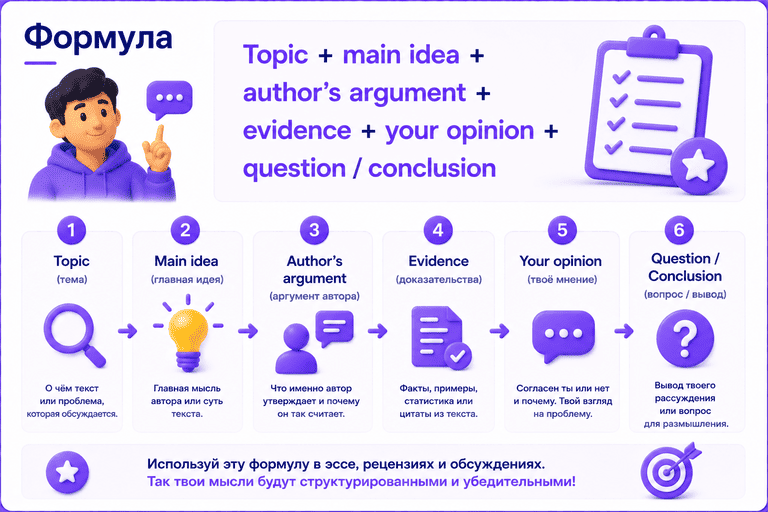
Главная формула обсуждения статьи
|
Формула |
По-русски: тема + главная мысль + аргумент автора + доказательства + твоё мнение + вопрос или вывод. Если ученик держит эту формулу в голове, обсуждение перестаёт быть хаотичным.
Пример: “The article is about social media and teenagers. The author argues that social media can damage concentration. The article gives examples from schools and mentions recent studies. I agree with the general idea, but I think the article is too negative. A useful question is: how can teenagers use social media without losing focus?”
Виды текстов: article, post, report, essay, review
Слово article часто переводят как “статья”, но в английском важно понимать, какой именно текст обсуждается. Статья в новостях, академическая статья, блог-пост и отчёт обсуждаются немного разными словами.
|
Тип текста |
Что это |
Как говорить |
|
article |
Статья в газете, журнале, на сайте или в учебнике. |
The article discusses... / The article focuses on... |
|
news article |
Новостная статья о событии. |
The article reports on... / According to the article... |
|
academic article |
Научная или учебная статья с исследованием. |
The study suggests... / The authors claim... |
|
blog post |
Личный или экспертный пост в блоге. |
The writer shares an opinion about... |
|
report |
Отчёт с данными, выводами и рекомендациями. |
The report shows... / The data indicates... |
|
review |
Обзор книги, фильма, продукта, сервиса. |
The review evaluates... / The reviewer points out... |
|
essay |
Аргументированный текст на тему. |
The essay argues that... / The writer supports this idea with... |
Как начать обсуждение статьи
Начало обсуждения должно быстро дать слушателю контекст. Не надо начинать с деталей. Сначала назови тему и общий фокус текста.
|
Фраза |
Перевод |
Когда использовать |
|
Статья о... |
Самое простое начало. |
|
|
Статья обсуждает... |
Когда статья разбирает тему. |
|
|
Статья сосредоточена на... |
Когда нужно показать основной фокус. |
|
|
Статья касается... |
Нейтрально, чуть более формально. |
|
|
Статья поднимает проблему... |
Когда есть социальная, научная или спорная тема. |
|
|
Статья рассматривает... |
Живой нейтральный вариант. |
10 готовых начал
- The article is about the impact of technology on education.
- The article discusses the problem of rising prices.
- The article focuses on how people learn languages online.
- The article deals with the relationship between sleep and productivity.
- The article raises the issue of mental health at work.
- The article looks at the reasons why people change careers.
- The article reports on new changes in the job market.
- The article explores the benefits and risks of artificial intelligence.
- The article compares traditional education with online learning.
- The article examines why many people struggle with long-term motivation.
Как пересказать статью кратко
Краткий пересказ - это не подробный перевод каждого абзаца. Summary должно передавать главную мысль и самые важные детали. Хороший пересказ отвечает на вопрос: “Что должен знать человек, который не читал статью?”
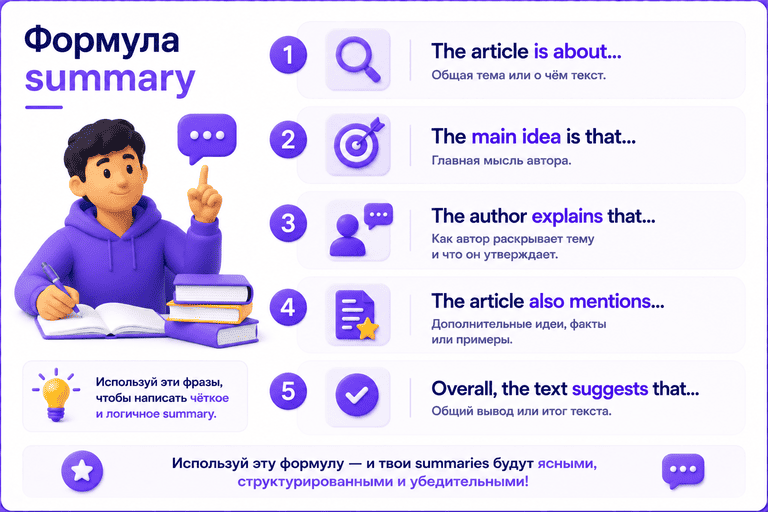
|
Функция |
Фраза |
Пример |
|
Назвать тему |
The article is about... |
The article is about the future of online education. |
|
Назвать главную мысль |
The main idea is that... |
The main idea is that online courses need structure. |
|
Позиция автора |
The author argues that... |
The author argues that motivation alone is not enough. |
|
Дополнительная деталь |
The article also mentions... |
The article also mentions the role of feedback. |
|
Общий вывод |
Overall, the article suggests that... |
Overall, the article suggests that learning works best with a clear system. |
Важно: summary не должно быть слишком личным. Сначала пересказ, потом мнение. Нельзя сразу начинать с “I like it”, если человек ещё не понял, о чём статья.
Пример хорошего summary
|
Example summary |
Как говорить о главной мысли автора
Когда обсуждаешь статью, важно отличать тему от главной мысли. Тема - это “о чём статья”. Главная мысль - это “что автор хочет доказать или объяснить”.
|
Тема |
Главная мысль |
|
The article is about online learning. |
The author argues that online learning works only when students have discipline and feedback. |
|
The article is about healthy food. |
The author suggests that people often underestimate the role of simple daily habits. |
|
The article is about social media. |
The writer claims that social media changes the way people compare themselves to others. |
|
The article is about business communication. |
The author believes that clear communication can prevent many workplace conflicts. |
|
The article is about climate change. |
The article suggests that individual actions matter, but systemic changes are more important. |
|
Фраза |
Перевод |
Нюанс |
|
Автор утверждает, что... |
Для сильной позиции с аргументами. |
|
|
Автор заявляет, что... |
Чуть сильнее, иногда звучит критично. |
|
|
Автор предполагает / говорит, что... |
Мягче, осторожнее. |
|
|
Автор указывает, что... |
Для важной детали. |
|
|
Статья подчёркивает, что... |
Когда мысль выделяется как важная. |
|
|
Текст подчёркивает важность... |
Для центральной идеи. |
Evidence: как обсуждать доказательства и примеры
Сильное обсуждение статьи почти всегда включает evidence - доказательства, данные, примеры, факты, исследования, цитаты. Если ученик говорит только “I agree”, это звучит бедно. Если он говорит “I agree because the article gives convincing examples”, речь сразу становится взрослее.
|
Слово / фраза |
Перевод |
Пример |
|
доказательства |
The article provides strong evidence for this idea. |
|
|
пример |
The author gives several examples from real life. |
|
|
данные |
The article uses data to support the argument. |
|
|
исследование |
The article refers to recent research. |
|
|
исследование |
The study shows a clear connection between sleep and memory. |
|
|
источник |
The article does not mention the source of this information. |
|
|
цитата |
The article includes a quote from an expert. |
|
|
пример / кейс |
The article includes a case study from a small company. |
|
Сильнее |
Слабее |
|
The article supports this point with clear data. |
The article says this. |
|
The example makes the argument more convincing. |
There is an example. |
|
The author refers to research, but the source is not explained. |
There is some research. |
|
The evidence is interesting, but it may not be enough to prove the conclusion. |
Maybe it is true. |
|
The article gives real-life examples, which makes the point easier to understand. |
The examples are good. |
Как выразить своё мнение
После пересказа можно переходить к мнению. Важно: мнение в обсуждении статьи должно быть не просто эмоциональным, а аргументированным. Лучше не “I like it”, а “I found the article useful because it explains the problem clearly”.
|
Уровень |
Фраза |
Как звучит |
|
Просто |
I think the article is useful. |
Нормально для A2-B1. |
|
С причиной |
I think the article is useful because it gives practical examples. |
Уже сильнее. |
|
Взрослее |
I found the article convincing because the arguments are clear and well-supported. |
Хороший B1-B2 стиль. |
|
Осторожно |
I partly agree with the author’s point, but I think the issue is more complex. |
Отлично для дискуссии. |
|
Критично |
I am not fully convinced by the conclusion because the article lacks evidence. |
Профессиональное несогласие. |
20 фраз для мнения
-
I think the article is useful because it explains the topic clearly.
-
I found the article interesting because it gives real-life examples.
- In my opinion, the author makes a strong point.
- I agree with the main idea of the article.
- I partly agree with the author, but I think the topic is more complicated.
- I do not fully agree with the conclusion.
- I am not sure the article gives enough evidence.
- The article made me think about this issue differently.
- The article seems balanced and well-structured.
- The article is useful, but it could include more examples.
- The author’s argument is clear, but some details are missing.
- I think the article exaggerates the problem.
- I think the article underestimates the importance of this issue.
- The article raises an important question.
- The article explains the problem well, but it does not offer a clear solution.
- I found the examples convincing.
- I found the conclusion too general.
- This article is relevant to real life because many people face this problem.
- The topic is important, but the article does not go deep enough.
- Overall, I think the article is worth reading.
Agreeing: как согласиться не бедно
Согласие должно быть точным. “I agree” - это только начало. Лучше сказать, с чем именно ты согласен и почему.
|
Фраза |
Перевод |
Пример |
|
Я согласен с главной мыслью автора. |
I agree with the author’s main point because the examples are realistic. |
|
|
Я разделяю мнение автора, что... |
I share the author’s view that education needs more structure. |
|
|
Эта мысль имеет смысл, потому что... |
This point makes sense because many students need feedback. |
|
|
Аргумент убедительный, потому что... |
The argument is convincing because it is supported by data. |
|
|
Я думаю, автор прав, говоря, что... |
I think the author is right to say that sleep affects productivity. |
Disagreeing: как не согласиться вежливо
Несогласие в английском обсуждении статьи лучше строить мягко. Не нужно говорить “The author is wrong”. Лучше: “I am not fully convinced” или “I think the article overlooks an important factor”.
|
Резко |
Взрослее и мягче |
Почему лучше |
|
The author is wrong. |
I am not fully convinced by this argument. |
Критика направлена на аргумент, не на человека. |
|
This is stupid. |
This point seems too simplistic. |
Звучит профессионально, а не грубо. |
|
I do not believe it. |
I would need more evidence to accept this conclusion. |
Называет проблему: мало доказательств. |
|
The article is bad. |
The article raises an important issue, but the argument is not fully developed. |
Есть баланс: плюс и минус. |
|
The author forgot everything. |
The article overlooks several important factors. |
Критика точная и нейтральная. |
|
Фраза для несогласия |
Перевод |
|
Я понимаю мысль автора, но не полностью согласен. |
|
|
Я частично согласен, но думаю, что ситуация сложнее. |
|
|
Аргумент интересный, но ему нужно больше доказательств. |
|
|
Я думаю, статья упускает важный фактор. |
|
|
Вывод кажется слишком общим. |
|
|
Эта мысль может быть верной в некоторых случаях, но не всегда. |
Hedging: как звучать умно и осторожно
Когда обсуждаешь статью, особенно на B1-B2, не всегда нужно звучать категорично. Hedging помогает говорить аккуратно: “may”, “might”, “seems”, “appears”, “could”, “to some extent”.
|
Категорично |
С hedging |
Перевод |
|
The article is wrong. |
The article may not be fully accurate. |
Статья может быть не полностью точной. |
|
This proves everything. |
This seems to support the author’s point. |
Это, кажется, поддерживает мысль автора. |
|
The problem is obvious. |
The problem appears to be important. |
Проблема, похоже, важна. |
|
This always happens. |
This may happen in many situations. |
Это может происходить во многих ситуациях. |
|
The conclusion is false. |
The conclusion might be too strong. |
Вывод может быть слишком сильным. |
|
The article is biased. |
The article seems somewhat biased. |
Статья кажется немного предвзятой. |
Hedging не делает речь слабой. Наоборот, он делает речь более взрослой, потому что человек показывает: “я понимаю нюансы, я не кричу, я анализирую”.
Как обсуждать сильные и слабые стороны статьи
Хорошее обсуждение часто включает strengths and weaknesses - сильные и слабые стороны. Это особенно полезно для уроков, экзаменов, speaking practice и анализа текстов.
|
Сильная сторона |
Как сказать |
|
Статья ясно объясняет тему. |
The article explains the topic clearly. |
|
Есть хорошие примеры. |
The article gives useful examples. |
|
Аргументы убедительные. |
The arguments are convincing. |
|
Статья хорошо структурирована. |
The article is well-structured. |
|
Тема актуальная. |
The topic is relevant to modern life. |
|
Автор показывает разные стороны. |
The author considers different sides of the issue. |
|
Слабая сторона |
Как сказать |
|
Мало доказательств. |
The article does not provide enough evidence. |
|
Слишком общий вывод. |
The conclusion is too general. |
|
Мало примеров. |
The article could include more examples. |
|
Одна сторона проблемы. |
The article presents only one side of the issue. |
|
Слишком эмоционально. |
The tone of the article seems too emotional. |
|
Нет решения. |
The article explains the problem, but it does not offer a clear solution. |
Bias: как говорить о предвзятости
Bias - это предвзятость. Не каждая статья нейтральна. Автор может выбирать только удобные примеры, игнорировать другую сторону, писать эмоционально или делать слишком сильный вывод. На английском это можно обсуждать аккуратно.
|
Фраза |
Перевод |
Когда использовать |
|
Статья кажется предвзятой. |
Общая осторожная критика. |
|
|
Автор показывает только одну сторону проблемы. |
Когда нет баланса. |
|
|
Статья игнорирует противоположные взгляды. |
Когда нет контраргументов. |
|
|
Язык довольно эмоциональный. |
Когда текст давит эмоциями. |
|
|
Вывод кажется слишком сильным. |
Когда вывод не следует из доказательств. |
|
|
Статья была бы сильнее с более надёжными источниками. |
Когда не хватает качества источников. |
Как задавать вопросы по статье
Умение задавать вопросы показывает, что ученик не просто пассивно прочитал текст, а подумал. Вопросы могут быть про причину, доказательства, последствия, альтернативы, мнение автора и личный опыт.
|
Тип вопроса |
Фраза |
Пример |
|
О главной мысли |
What is the main point of the article? |
What is the main point of the article? |
|
О позиции автора |
What does the author argue? |
What does the author argue about online education? |
|
О доказательствах |
What evidence does the author provide? |
What evidence does the author provide to support this idea? |
|
О слабости текста |
What is missing from the article? |
What is missing from the article in your opinion? |
|
О последствиях |
What could happen if this trend continues? |
What could happen if this trend continues? |
|
О личном мнении |
Do you agree with the author? Why? |
Do you agree with the author’s conclusion? Why? |
20 вопросов для обсуждения любой статьи
- What is the article mainly about?
- What is the author’s main argument?
- What problem does the article discuss?
- What solution does the article suggest?
- What examples does the author give?
- What evidence supports the main idea?
- Do you find the argument convincing? Why?
- What part of the article did you find most interesting?
- What part of the article did you disagree with?
- Does the article seem balanced or biased?
- What information is missing from the article?
- How is this topic connected to real life?
- Can you give a real-life example of this problem?
- What could be a different point of view?
- What questions would you ask the author?
- What is the strongest argument in the article?
- What is the weakest argument in the article?
- What did you learn from the article?
- Would you recommend this article? Why?
- What is your final opinion about the topic?
Linking phrases для обсуждения
Чтобы речь не звучала как набор отдельных предложений, нужны связки. Они показывают переход: добавление, контраст, причина, пример, вывод.
|
Функция |
Фразы |
Пример |
|
Добавить мысль |
also, in addition, moreover |
The article also mentions the role of motivation. |
|
Противопоставить |
however, on the other hand, nevertheless |
However, the article does not explain the risks. |
|
Дать причину |
because, since, as |
I agree because the examples are realistic. |
|
Дать пример |
for example, for instance |
For example, many students need feedback. |
|
Сделать вывод |
overall, in conclusion, to sum up |
Overall, the article is useful and balanced. |
|
Уточнить |
in other words, to be more specific |
In other words, the author thinks structure is more important than motivation. |
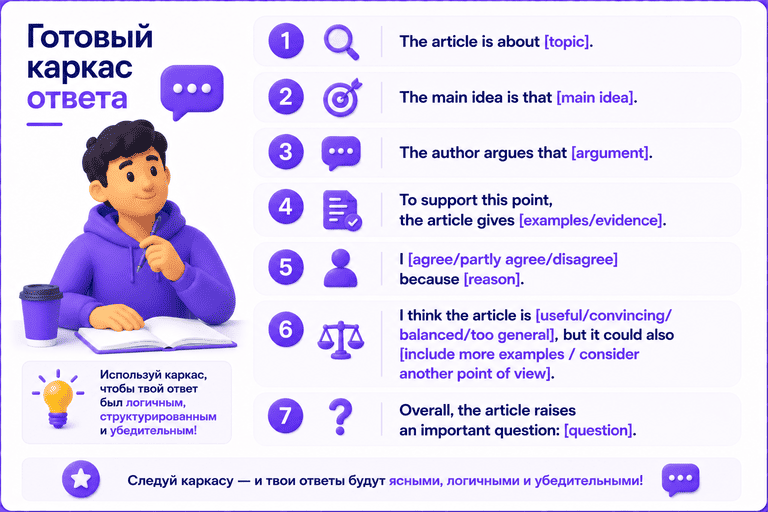
Типичный план устного ответа по статье
Для speaking practice можно использовать стабильный план. Он помогает не застрять и не говорить хаотично.
1. Name the topic: The article is about...
2. State the main idea: The main idea is that...
3. Explain the author’s argument: The author argues that...
4. Mention evidence or examples: The article gives examples of...
5. Give your opinion: I agree / partly agree / do not fully agree because...
6. Evaluate the article: The article is useful / balanced / convincing / too general.
7. Finish with a conclusion or question: Overall... / A useful question is...
Диалоги: как обсуждение звучит вживую
Диалог 1. Простое обсуждение
|
Dialogue |
Диалог 2. Частичное согласие
|
Dialogue |
Диалог 3. Критика статьи
|
Dialogue |
Mini-scenarios: реальные ситуации
Сценарий 1. Урок английского
Учитель просит обсудить короткую статью о здоровом сне. Слабый ответ: “It is about sleep. I agree.” Сильный ответ:
|
Strong answer |
Сценарий 2. Собеседование
На собеседовании кандидата спрашивают о статье про remote work. Важно показать не только английский, но и мышление.
|
Strong answer |
Сценарий 3. Университет или курс
Студент обсуждает статью с данными. Здесь лучше говорить о evidence, source, data, conclusion.
|
Strong answer |
Частые ошибки русскоязычных учеников
|
Ошибка |
Почему плохо |
Лучше |
|
The article tells about... |
Tell about звучит неестественно для описания статьи. |
The article is about... / The article discusses... |
|
Author says that... |
Нужен артикль the: the author. |
The author says that... / The author argues that... |
|
I am agree with author. |
Agree - глагол. Нужны I agree и the author. |
I agree with the author. |
|
I very like this article. |
Very не ставится перед like. |
I really like this article. |
|
In article we can see... |
Нужен the article. Лучше не злоупотреблять we can see. |
In the article, the author explains... |
|
The article is actual. |
Actual не значит актуальный в этом смысле. |
The article is relevant. |
|
I think yes. |
По-русски понятно, по-английски бедно. |
I agree because... / I think this is true because... |
|
The article has many proofs. |
Proofs часто звучит неестественно. Лучше evidence. |
The article provides a lot of evidence. |
|
I disagree with this article. |
Можно, но точнее говорить с чем именно. |
I disagree with the author’s conclusion. |
|
This theme is important. |
Theme не всегда подходит. Лучше topic/issue. |
This topic is important. / This issue is important. |
Слова, которые часто нужны для обсуждения статей
|
English |
Русский |
Пример |
|
topic |
тема |
The topic is relevant to many people. |
|
issue |
проблема / вопрос |
The article raises an important issue. |
|
main idea |
главная мысль |
The main idea is clear. |
|
argument |
аргумент / позиция |
The argument is convincing. |
|
evidence |
доказательства |
The article needs more evidence. |
|
source |
источник |
The source is not mentioned. |
|
claim |
утверждение |
This claim needs stronger support. |
|
conclusion |
вывод |
The conclusion seems too general. |
|
balanced |
сбалансированный |
The article is balanced. |
|
biased |
предвзятый |
The article seems biased. |
|
convincing |
убедительный |
The examples are convincing. |
|
relevant |
актуальный / относящийся к делу |
The article is relevant to modern life. |
|
practical |
практический |
The advice is practical. |
|
general |
общий |
The conclusion is too general. |
|
specific |
конкретный |
The article gives specific examples. |
Полный пример обсуждения статьи
Ниже пример ответа, который можно использовать как модель. Он не слишком сложный, но звучит взросло, логично и подходит для B1-B2.
|
Full model answer |
Разбор полного ответа
|
Часть |
Фраза из ответа |
Зачем она нужна |
|
Topic |
The article is about the influence of smartphones on concentration. |
Сразу ясно, о чём статья. |
|
Main idea |
The main idea is that people often lose focus... |
Передаёт центральную мысль. |
|
Author’s argument |
The author argues that constant notifications... |
Показывает позицию автора. |
|
Evidence |
The article gives examples from students and office workers. |
Упоминает поддержку идеи. |
|
Opinion |
I agree with the author’s main point because... |
Даёт мнение с причиной. |
|
Balance |
However, I think the article could also mention... |
Добавляет нюанс, не слепое согласие. |
|
Evaluation |
Overall, the article is relevant and easy to understand... |
Оценивает качество текста. |
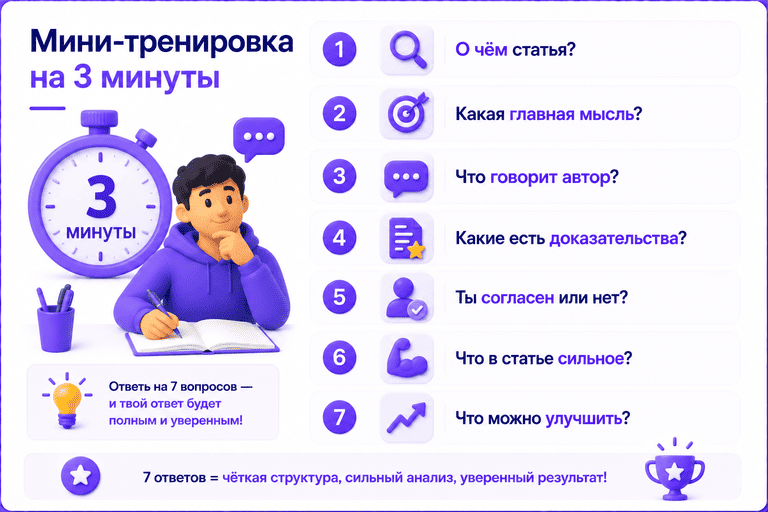
Как тренировать эту тему
Самый быстрый способ научиться обсуждать статьи - не читать огромные тексты, а регулярно брать короткие статьи и прогонять их через одну и ту же схему. Нужно тренировать не “перевод”, а структуру ответа.
1. Прочитай заголовок и скажи: The article is about...
2. Найди главную мысль и скажи: The main idea is that...
3. Определи позицию автора: The author argues/suggests/claims that...
4. Найди один пример или факт: The article gives an example of...
5. Скажи мнение с причиной: I agree/partly agree because...
6. Назови одну сильную сторону: The article explains the topic clearly.
7. Назови одну слабую сторону: The article could include more evidence.
8. Заверши выводом: Overall, I think the article is useful because...
Краткий итог
- Discussing articles - это навык анализа текста, а не дословный перевод.
- Сначала нужно назвать тему и главную мысль, потом уже выражать мнение.
- Сильная речь использует фразы: The article discusses..., The author argues..., The evidence suggests..., I partly agree..., The article overlooks...
- Хорошее мнение должно иметь причину: because, since, for example.
- Взрослая критика направлена на аргумент, доказательства, баланс и вывод, а не на личные эмоции.
- Для B1-B2 важно использовать hedging: may, might, seems, appears, to some extent.
- Универсальная формула: topic + main idea + author’s argument + evidence + your opinion + conclusion.
Что изучать дальше
- Opinion language: how to agree, disagree and give reasons.
- Linking words: however, moreover, therefore, although, despite.
- Academic English: hedging, evidence, argument, source, claim.
- Critical thinking vocabulary: biased, balanced, convincing, relevant, reliable.
- Speaking practice: short summaries and article discussions.